
Messages in Blood
by Jay Grant
The first drop lands in her coffee.
Mrs Ellis doesn’t notice. She’s reading the news on her tablet, spoon halfway to her mouth. The radio hums with soft jazz. Her cat weaves under the table, disinterested in both her company and her cereal.
The second drop hits her cornflakes.
This time, she frowns. The milk ripples, tinged pink. She dips her spoon and stirs, thinking perhaps it’s a rusty drip from the ceiling fan. The next drop lands square in the centre of the bowl – thick, red, unmistakable.
She looks up.
Her kitchen ceiling is sodden with dark, red-black blood. Another bead forms, swells, and falls, landing right on her face.
She screams.
* * *
Thirty minutes later, Ben steps through the outer doors of St. Mark’s Estate, coat still zipped, boots quiet on the hallway tiles. She passes beneath the strip of yellow tape and nods to the officer stationed outside flat 1B.
Mrs Ellis sits on the stairwell, wrapped in a green dressing gown, arms clutched tightly across her chest. One slipper is missing. An officer crouches beside her, murmuring questions into a notepad.
“She says she noticed it around six fifteen,” he tells Ben. “No sounds from upstairs. No scuffle or anything. Nothing out of the ordinary.”
“Upstairs?”
“Flat 2B. Daniels is up there, Landlord let him in.”
Ben nods, already moving through the open door.
Inside 1B, the kitchen is still.
Blood drips steadily from the ceiling. The plaster is starting to split – heavy and dark with saturation. It gathers on the light fixture, slides down the chain, and lands in soft, irregular pats on the table.
Ben pauses. Then turns, kneels by her kit bag, and begins suiting up – hood up, gloves half-on – when Daniels’ voice echoes down the stairs.
“Where’s Ben?”
“I’m here,” she says, climbing the stairs, taping up her wrists, face mask looping over one ear.
“Hope you skipped breakfast,” Daniels mutters as she reaches the top. “Pretty grim.”
She steps into the flat – and freezes.
So much blood.
She scans the volume instinctively – five to six litres. A full body’s worth.
But no body.
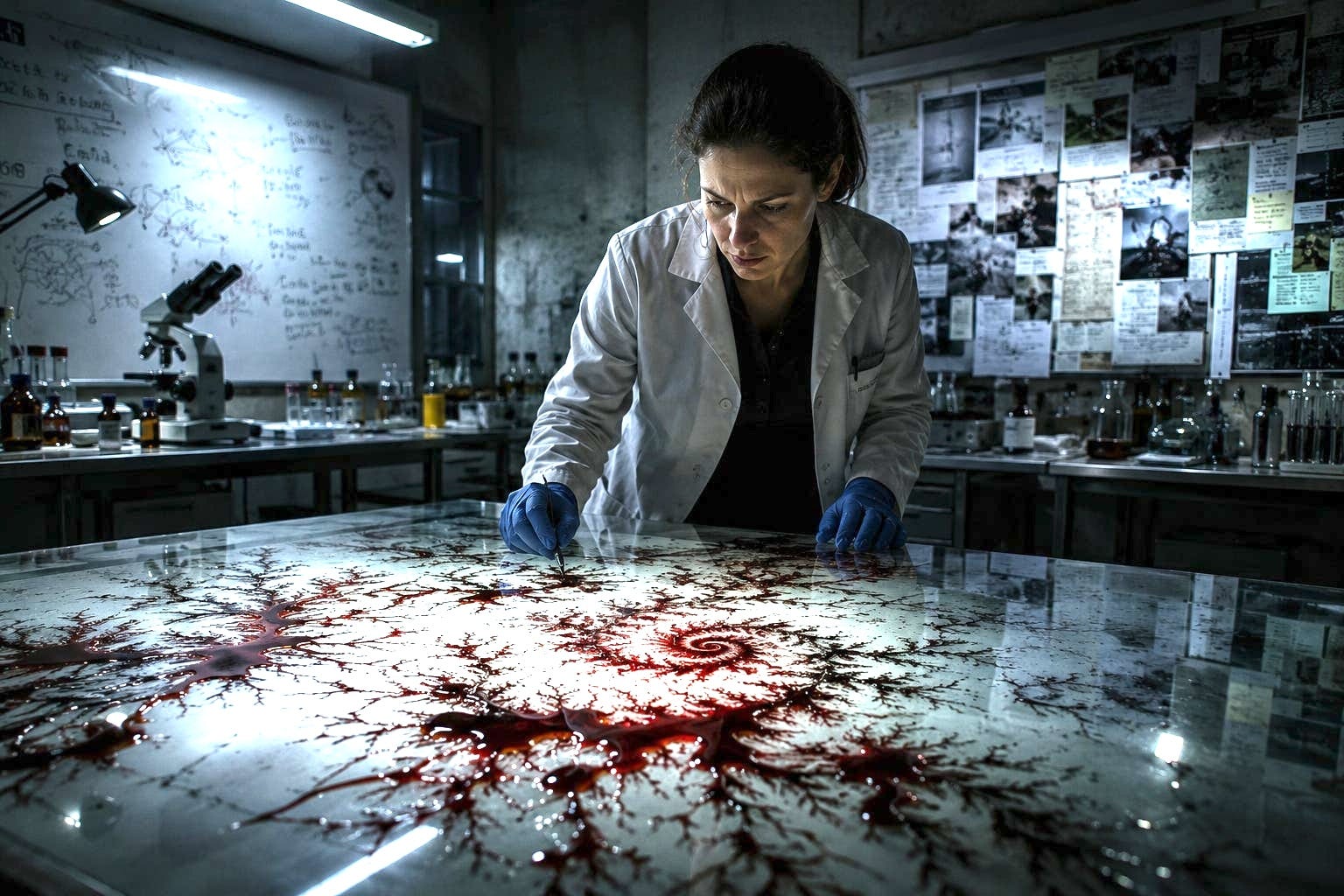
The entire kitchen floor is covered in a wide, irregular pool – deep red, dense at the centre, feathering outward in soft radial waves. It stretches nearly wall to wall, brushing the skirting boards, creeping beneath the cabinets. The impact zone is obvious: a central splash point, low velocity, gravity-fed. Not sprayed. Not cast off. Just released – all at once – from height.
Thin trails arc towards the lower cupboards. Fine mist dots the skirting, no higher than a foot. Secondary spatters along the base of the walls mark the outer range of the splashback. Nothing on the upper surfaces.
Daniels stands in the doorway. “They bled him out here, hauled him off. Staged it clean. Has to be.”
Ben doesn’t look up. “Nope. No drag. No smear. No clean-up. Look at the pool. It dropped – not dripped. All at once. Straight down.”
He snorts. “What, he dissolved?”
“Well, that’s one way to put it.”
“Find me a body, Ben,” Daniels says, already turning away.
She steps forward, careful not to disturb the edges, and taps her mic. “Pattern consistent with mass drop from mid-height – estimate four to five feet. Radial dispersion at floor level, minimal upward arc. Impact energy low but uniform. No arterial mist. No cast-off. No evidence of clean-up. Victim’s clothes located centrally within the main pool. No sign of struggle. No motion artefacts.”
She moves closer. A glint catches her eye – faint, but wrong. “Primary pool shows signs of central dampening. Possible absorption – the victim’s clothing may have disrupted initial dispersal.”
She crosses to the doorway, pauses, and looks back. “Volume consistent with complete exsanguination. No sign of restraint. No indication of impact trauma.”
She lets the mic drop from her lips. A silence settles.
Even in the strangest scenes – dismemberments, high-pressure wounds, suicides – there was something to go on. A fleck. A spray arc. A smudge on a doorknob. But this?
This is silence.
And something else.
She pauses. The blood shimmers ever so slightly. The edges curl inward with a precision no random spill could form. Too ordered. Too deliberate. No one else would’ve noticed. But Ben reads patterns in chaos, sees code where others see noise. She doesn’t just see – she feels. Always has. And right now, her whole body is tingling.
This pool isn’t just blood. It’s a message etched in red, whispering secrets only she could hear.
But what?
She pulls her gaze away. Looking around the room, scanning the bookshelves.
Titles on cognition, symmetry, prime numbers – all worn at the spine, heavily used. Fractal geometry. Algorithmic composition. Nonlinear systems. No filler. No fiction. Just deep, deliberate knowledge.
On the desk: a sketchpad.
Pages of spirals, ratios, looping sequences of numbers.
Drawn with precision. Annotated with care.
Obsessive, yes – but not erratic.
She stares at the sketchpad, then back at the blood.
Something about it all aligns – like pages torn from the same book, scattered and waiting to be read.
She isn’t sure what it means. But she knows this:
Whatever has happened here – it wasn’t an accident.
And it wasn’t over.
* * *
By the time Ben makes it back to the forensics suite, the samples are already logged and the photos uploading to evidence. The hum of extraction fans replaces the silence of the flat. She peels off her gloves, sets her notebook on the bench. Daniels is waiting in one of the lab’s office chairs, incident file open on his lap.
“DNA’s a match to the occupant. Male. Twenty-two. Name’s Callum Wright. Lived alone. Pattern analyst for a private data firm. Remote work. Quiet type. Kept to himself. Harper’s with the parents now, we should have her profile soon. Anyway, the hair we found in the bathroom matches. It’s his blood.”
She nods slowly. “All of it?”
“All of it. You were right, it’s a full body’s worth, right there on the floor. But no forced entry. Door locked from the inside. Windows sealed. He went in alone. No one followed. No one came out. It’s like he bled himself dry then just disappeared. I’m stumped.”
“Any foreign DNA?”
“Nope, nothing. No prints, no footprints, no stray hairs, no skin cells that aren’t his. Place is cleaner than a nun’s knicker drawer. Either the kid had some serious OCD or someone wiped it down like a pro.”
He taps the next page.
“And the clothes – they’re his. Confirmed by the mother. Hoodie, jeans, socks, slippers. But get this – shirt buttoned up, jeans zipped, belt tight, socks inside the slippers like he stepped out of ’em mid-stride.”
He leans back slightly, watching her.
“If it’s staged, it’s flawless. But who drains a body and throws a bunch of clothes in the middle of the puddle? Doesn’t make sense.”
Ben taps her notebook with her pen. She’s been doodling, patterns in the margin. She blinks. Once. “It wasn’t staged.”
He exhales, not quite a laugh. “OK, Sherlock, so he vanished. Just forgot to take his blood with him. It’s either a prank, or we’re looking for a master magician.”
Ben keeps her eyes forward. “If it was staged,” she says finally, “where’s the stagecraft? There’d be evidence, some kind of trace. No crime scene is that perfect.”
Daniels scowls. “Ok, when you work it out, let me know.” He prepares to leave. “Oh, almost forgot. Contact lenses. Floating in the middle of the pool. Make of that what you will.” He slides an envelope across the table. “The stills you asked for.”
He steps out, closing the door behind him, leaving Ben alone.
Ben plugs the USB into her laptop and opens the first set of images.
Wide shots of the room. The pool. The clothes. Every detail crisp. She scrolls, slowly – pausing on one frame. Near the bookshelf. The outer fringe of the pool. Glossy. Slick. Off.
She zooms in.
At first, she thinks it’s simple congealing – the slow tightening at the edges.
But then she sees them.
Ridges.
Not random. Regular.
This isn’t coagulation.
She adjusts the contrast. Leans closer.
Tiny spirals. Perfect arcs. Repeating outward from a central point.
Geometry.
Fractals.
Something has altered the blood at the molecular level. A moment of high energy perhaps – brief but concentrated. Enough to change the way the blood has settled.
Her breath catches.
The blood hasn’t merely fallen – it’s been charged.
She reaches for the vial, draws a sample onto a slide, and slides it under the microscope.
Focus.
There it is. The same spirals. The same impossible order.
She stares, unblinking.
Something has happened here.
And it’s left a signature.
She leans back, unsettled. If this is random, it’s the most deliberate chaos she’s ever seen.
Her phone rings.
She flinches. Sits back. Looks at the screen.
Daniels.
She answers.
His voice, calm and steady. “Ben? We’ve got another one.”
* * *
The blood is still moving when Ben steps into the Royal Concert Hall. Seeping through the grout between tiles like it’s searching for something.
She stands in the women’s restroom, just off the main foyer, half-lit fluorescents buzzing above tile and chrome.
An entire body’s worth of blood slicks the floor. No spray, no splatter, no smear – no body.
Just blood.
The stall had been locked from the inside. When staff had forced it open, they found a pile of still-fastened clothes, completely drenched. No sign of struggle, no footprints. Just like the first scene. A violin case leans between the toilet bowl and the tiled wall.
Ben stares. The blood, still fluid – no congealing, no dulling at the edges. Just that impossible sheen, pooling beneath the stall door.
She crouches, tilting her head. A droplet catches the light – its edge twisting into a faint crystalline spiral. Then it relaxes again, as if shy.
“One of the caretakers was here when it happened,” says the officer at the door. His voice tight – eyes hollow. “Didn’t see anything, but says he heard something in the stall. Then the blood started pouring out. He’s in the green room now. Shaken up.”
“Cameras?” Ben asks, rising.
“They’re pulling the feed now.”
She peels off her gloves. “Let me speak with him.”
* * *
The caretaker sits in the green room, clutching a tea mug with both hands, even though it’s empty. He taps the rim with a fingernail – tik, tik, tik. His polo shirt is damp under the arms, and his theatre lanyard sits skewed around his neck.
He looks up as Ben enters, eyes pinched, more confused than scared.
“Didn’t think anyone was in there,” he says, voice low. “Routine cleanliness inspection, you know? I swear I knocked. Called out. No answer.”
He puts down the mug and rubs his palms on his thighs. “Started mopping, that’s when I heard it. From one of the stalls. Just one word. ‘Yes.’ A woman’s voice, she sounded calm like. Like... like she was agreeing to something.”
He goes quiet, gaze slipping sideways. “Next thing I know, blood’s coming out under the door, like a bloody horror movie. Just kept coming, like someone tipped over a bucket.” He gives a half-hearted shrug. “I didn’t touch anything. Just backed out and called security.”
He looks back at her. Sheepish. “They won’t pin this on me, will they?”
Ben shakes her head. “No one’s blaming you. But that word – ‘yes’ – you’re sure?”
“Yep. Just like that. ‘Yes.’ I turned to look and – bam – blood everywhere.”
He shivers.
“And you only heard one voice?”
“Just the one.”
Ben gives him a nod. “OK, thanks.”
Back in the restrooms, Ben steps inside as the team complete their scans and prep for cleanup.
“We found these,” one of the techs says, holding up an evidence bag. Inside – three small grey fragments. “My guess is tooth fillings. Found ’em with the clothes.”
Ben nods, her eyes drifting back toward the floor. The blood dragging oddly beneath the mops – too fluid, too bright. It wasn’t behaving the way blood should.
Then she saw it.
In the wake of a mop stroke, where a smear caught the light. A streak that shimmered. Within it – faint curls. Etched in residue, delicate and deliberate. Spiralling.
A pattern.
* * *
Ben leaves the Festival Hall just after 4 p.m., the blood sample packed and sealed in a steel case beside her. By 4:30 p.m. she’s back in the lab.
The blood is still fresh. That much is clear. But that’s not the problem.
The problem is how it’s behaving.
She draws a sample onto a slide and peers through the scope – still fluid, unnaturally so. No platelet clumping. No oxygen breakdown. No clotting.
And there they are, along the droplet’s outer edge.
Fractals.
Fibonacci spirals.
Order where there should be chaos.
She adjusts the lens. Some of the curls arc inward, folding on themselves with a slow, methodical grace.
She leans back, unsettled.
The lab door clicks open.
Daniels steps in, jacket off, sleeves rolled. “Harper’s on her way up,” he says, slumping into a chair. “You look like hell.”
“Thanks,” Ben mutters, eyes still on the scope.
Daniels drops a slim folder onto the desk. “We’ve got nothing. No bodies, no prints, no weapons. Just some bloody magician with a warped sense of humour. I need something that points somewhere.”
The door opens again. Harper steps in, shutting it quietly behind her. “Hey,” she says, sliding into the chair across from Ben.
Ben gives a faint smile.
“You alright?” Harper asks. “You look wiped. Might be time to take a break.”
“I’m fine,” Ben says. “Thanks though.”
Harper nods. “Anytime.”
They share a glance – brief, warm.
Daniels doesn’t notice.
Harper opens the folder, scanning as she speaks. “The woman from the Royal Concert Hall, she’s thirty-one, single, musical prodigy. Played the Proms at fourteen. Dental records confirm, she had three fillings. The man in the flat? Twenty-two, machine learning specialist – diagnosed OCD, high functioning, but severe, focused on pattern recognition. He started at UCL at sixteen, dropped out after a year, self-taught from there. Both tested off the charts. Both tagged ‘exceptional’ before age ten.”
“Both loners,” Daniels adds. “Didn’t drink, no drugs, no social media. Parents describe them as driven.” He gestures between them. “It’s not much, but it’s the only link we’ve got. You’ve got brains, instincts, and a microscope. I need something I can use, and fast.”
He leaves without waiting for a reply.
Ben steps back from the scope. “Take a look.”
Harper leans in and adjusts the lens, quiet for a beat. “It’s blood.”
“Nothing else?”
Harper looks up. “What am I supposed to see?”
Ben doesn’t answer. She returns to the eyepiece. Watching.
Harper crosses her arms.
Ben doesn’t move. Then softly, “It’s moving. Fractals. Alive.”
Harper takes another look.
“At the edges, see?” Ben asks.
Harper looks up. “You sure?”
Ben flinches. “You think I’m imagining things?”
“I think you’re tired. You probably should take a break.”
A knock at the door. Daniels steps back in, holding a USB. “Footage from the concert hall. Corridor cam. No one’s seen it yet.”
He passes it over and stands behind them as Ben plugs it into her laptop. Harper pulls up a chair.
The footage loads – grainy black-and-white, fixed angle down the tiled hallway outside the women’s washroom.
Timestamp: 12.47
The girl enters frame – slight, calm. She carries a violin case, pauses at the door, then pushes inside.
Stillness.
Timestamp: 12.50
The caretaker appears – mop bucket trailing behind. He knocks. Waits. Knocks again. Then enters.
The corridor remains empty.
Timestamp: 12.52
Then – the slightest flicker.
Not quite a glitch. More like a tiny shimmer near the far wall, like heat rising off tarmac. The overhead light dims, then steadies again.
Nothing enters. Nothing leaves.
The caretaker reappears – stumbling backward, then running.
They keep watching. The corridor remains empty.
A minute passes.
Then the caretaker returns – this time with Security.
Timestamp: 12:54
Daniels’ phone rings – the shrill tone cutting the silence. They all jump.
He answers. Listens. “Shit. Another one. Piccadilly Tube Station. Now.”
Harper’s already rising, chair scraping. “Three in twelve hours. This is madness.”
Ben doesn’t move.
Her gaze drifts to the window – rain tracking across the glass. For a second, the droplets curve into spirals. Fractals. Fleeting. Then gone.
She blinks. Just water.
“Ben,” Daniels barks. Sharper than usual. “Let’s go.”
She nods slowly, taking one last, long look at the window, and follows them out.
Behind them, the laptop remains open, footage still playing.
Timestamp: 12:56
Empty corridor.
Then – a flicker.
A distortion sharpens, just for a frame: a face. Fractal-edged. Eyes like coiled infinity.
No mouth. No motion.
A single frame.
Then: static.
The screen goes black.
* * *
By the time Ben arrives, Piccadilly Station is in full lockdown. Cordons block every entrance. The platforms have been cleared, except for the passengers from the affected carriage, sitting in stunned silence while emergency services tend to them.
Fluorescents flicker overhead, casting harsh light on pale concrete and bloodstained tiles. A group of witnesses huddle near the exit tunnel, their faces blank, eyes wide, many spattered in blood. Some tremble uncontrollably, clutching at their arms, while others simply stare, too shocked to move. A man in a white shirt is soaked, blood blooming across his chest and arms, his hands shaking violently as paramedics crouch beside him. Nearby, a woman in heels mutters under her breath, blood matted in her hair, her lips pressed tightly together as if in disbelief. Children cry, too numb to understand what has happened, while others stumble about, disoriented, struggling to make sense of the nightmare they are living through.
Two firefighters work methodically, hosing down the platform, scrubbing away the bloody footprints.
“Stop those damn hoses!” Daniels barks. “Don’t touch anything! This is a goddamn crime scene, not a car wash!” He strides toward the train, fury in his every step. “Stop those witnesses. Did anyone clear them? Who said they could leave?” He spins on a constable with a clipboard. “Who the hell told them to start cleaning?”
The stench hits Ben halfway down the platform – the thick, unmistakable smell of blood and panic. She pulls on fresh gloves. The open carriage doors gape like a wound.
Inside, the walls are slick. Blood clinging to windows, handrails, seatbacks. It drips from the ceiling in slow, fat drops, like bloody drizzle. Inside, every surface glistens. Seats, poles, windows – all streaked and spattered like someone had detonated a blood bomb. It hadn’t just fallen this time. It had erupted.
She feels the pressure shift behind her. Daniels is pacing outside, phone pressed to one ear. Furious. “It’s confirmed,” he says. “No body, victim vanished. Same as the others.”
Ben nods, barely hearing him, her focus locked on the blood. It’s everywhere – smeared, streaked, dripping. She crouches beside the central pool, recorder in hand, eyes tracing the chaos. “Piccadilly southbound platform. Time of incident, approximately 5:30 p.m. Victim unconfirmed. High-volume dispersal – multi-directional, erratic.”
She tracks a spray arc – forward across the seats, upward to the ceiling, diagonal against the windows. Not the clean drop of the first case, not the fluid crawl of the second. Something’s shifted. She tilts her head, mind racing. “Initial hypothesis: train motion. Ruled out – blood’s not dragged one way. Sudden braking?”
She pauses the recorder, fingers hovering. No. Too simple. Physics doesn’t explain this – this is high-energy, unnatural. She clicks it back on, voice steady, cutting. “The velocity defies gravity – streaks climbing upward, smears across the ceiling, arcs on the windows.
She rises, scanning the rest of the carriage – blood glints under flickering light, shimmering faintly, still settling. The others were solitary, contained. This one’s public, surrounded – witnesses drenched, kinetic chaos pulsing. There were a lot of people, body heat, too much life. Her breath catches as the pieces snap together. “Proximity,” she murmurs into the recorder. “Crowd density amplified it – energy spiked, scattered the dispersal.”
The blood near her boots shimmers – tiny spirals catch her eye, curling and collapsing across the floor. Geometric. Ordered. The hum’s there – faint, but steady – thrumming beneath the streaks, vibrating up her spine. It drowns the station’s din – radios fuzzing, a distant train’s screech fading to white noise.
She freezes. A teddy bear lies on the floor, blood-spattered, its button eye glinting. Her chest tightens. A memory slams in, sharp as glass.
She’s twelve, racing her kid brother home from the corner shop. High summer, dusk painting the sky gold. He’s all elbows and knees, grinning, little legs pumping.
“You’re too slow, Bernice!” he taunts, laughing.
Then – the car. Black. Screaming tires. Too fast.
She yells his name – too late. Metal crunches bone. Blood blooms on asphalt, warm on her hands, her knees. Tom’s face – still, too still. His teddy, soft and small, lands spattered beside him.
She didn’t mean to trap it – the plate (XJ54 KLR), the windscreen’s spiderweb crack, the driver’s face. Her mind seized it all, frame by frame, unblinking.
An officer knelt beside her; voice steady. “You got the plate? That’s a gift, love. You helped us.” It was a hit and run. Drunk. They got him.
Afterwards, everything stuck – Tom’s shoe in the gutter, his laughter cut short, the blood’s tacky heat. She tried to forget, but she couldn’t.
From that day forward, she remembered everything.
Her teachers called her gifted; the kids called her freak. And sometimes, when the images wouldn’t stop, she believed them.
Her mind didn’t work like theirs. It couldn’t forget. It stored things. Every detail, every date, every angle. Voices, faces, the smallest movements. Like a camera that never blinked. Like a machine.
The only thing that stayed with her more than the memories was the voice of the policeman who knelt beside her at the scene. He’d placed a warm hand on her shoulder, looked her straight in the eye and said, “You helped. We got him. All thanks to you.”
It had rewired something.
This was the real gift. Not memorising licence plates. Not perfect recall.
Helping.
That’s why she’d chosen forensics. Not because it made her feel smart. Or righteous. Or even useful.
Because it made her feel human.
It was how she connected – to people, to grief, to justice. It was how she fought back against the numbness. She could stand beside families who had nothing left but questions. She could give them answers. She could stop the bad ones from doing it again.
She didn’t do it for recognition. She did it for Tommy.
And every time the blood told its story, she listened.
Her eyes open.
The patterns are gone. Just blood now.
The platform noise crashes back in – radios, voices, the slap of someone running down the stairs, approaching.
It’s Daniels, standing in the carriage doorway, shouting her name. “Ben! Witness. Saw it happen. Move your arse.”
Ben glances at the streaked ceiling, rivulets on the glass. Something shifts in her chest, cold, sharp, certain.
This won’t be the last.
* * *
The woman sits on a bench just outside the cordon, elbows on her knees, hands clasped tight. Her navy scrubs are dark with stains, splattered across the fabric, but she doesn’t seem to notice. She isn’t trembling. Just still. Watching.
Ben approaches. “You saw it happen?”
The woman nods. She’s in her early thirties. Clear eyes. NHS badge clipped to her top. ‘C. Patel.’ “Yeah, my shift finished at five-thirty. I was heading home.”
Her voice is steady, but her hands flex in her lap. “She was standing maybe six feet from me, holding the pole. She looked normal, calm. But she was staring. Really staring, at the empty space across from her. Not blankly. Focused, like... like someone was there.”
She glances down at her stained scrubs. “That’s why I noticed her. The way she was just locked in, staring at nothing.”
Ben crouches. “Did she say anything?”
“Not that I heard. I’d gone back to my phone, but then...” Patel stops, takes a breath. Her lip trembles. “Then it just happened. One second, she was there. The next, it was like her whole body just collapsed into blood. No sound. No scream. Just a curtain of red.”
Ben keeps her tone neutral. “Did the body fall? Hit the floor?”
“No. It didn’t fall. It vanished. There was nothing left. Just blood. Everywhere.”
“Did you see anyone else? Anyone near her, watching, walking away?”
Patel shakes her head, eyes distant. “I swear there was no one. And no one could leave – the train was still moving. People were screaming. Someone hit the alarm. When the train stopped, the doors were still locked. People were panicking. One guy was trying to smash the window. Then the doors finally opened, and everyone ran.”
Ben watches her for a moment. “Anything else? Anything strange just before?”
Patel hesitates, looking down at her lap, as if gathering her thoughts. “The lights were flickering. Just before it happened. But that’s normal on the tube.”
Ben stands, her expression unreadable. “Thanks.”
She turns to go, but the floor seems to tilt beneath her. For a heartbeat she sways, one hand on the wall. Fractals flash behind her eyes – curling, twisting, tugging at something inside her.
The hum of the lights deepens, the air thickens. Her pulse spikes. She grips the recorder, knuckles white.
Not now.
The pressure builds behind her eyes; sweat prickles along her hairline. Her breath shortens, the patterns tightening like a net.
Come on, Ben, focus.
Then, just as suddenly, it ebbs. The noise in her head fades to a dull hiss.
Her phone buzzes. It’s Harper: You ok?
Ben’s fingers tremble slightly as she swipes it open, the words on the screen swimming in her vision. She can feel the weight of her thoughts, the spirals coiling around her. They’re getting more insistent, more demanding.
Daniels calls out from nearby, his voice cutting through the static in her head. “Security’s got the footage. Let’s go.”
Ben doesn’t respond right away, the noise of the station comes crashing back in. But it pulls her forward, dragging her out of the spirals for a moment. She nods to Daniels, swallowing down the unease still crawling up her throat. “Yeah,” she mutters, more to herself than anyone else. “No time to spiral now.”
She types a quick reply to Harper – I’m ok – and hits send.
Her chest still tight, she walks toward the security office, the weight of the moment pressing against her ribs, but at least she’s moving again.
The security office is small and over lit, the air humming with static and burnt coffee. A row of monitors displays various feeds – platforms, escalators, entrances. One screen shows the taped-off train, hazmat teams now working methodically through carriage four.
Daniels stands at the desk, Ben at his side. A transit supervisor leans in the doorway while a young operator clicks through windows on the screen.
“I’ve cued it from Gloucester Road,” the operator says. “That’s where she got on.”
“Alone?” Daniels asks.
“Yeah. Rear-facing camera picked her up.”
“Anyone board the stop before the incident?”
“Green Park. Two boarders on that carriage, one male, late thirties, briefcase. Female, twenties, gym kit. They stayed near the doors. No contact.”
“Alright. Let’s see it.”
The operator clicks the mouse and the footage plays. At Gloucester Road, a few passengers step into the carriage. It’s busy – not packed, but all the seats are taken. Some stand near the doorways, others hold the overhead rails, swaying with the motion.
Amid them, a girl.
“That’s her,” the supervisor says.
Eighteen, maybe. Dressed all in black – hoodie, ripped tights, boots with thick soles. Goth without theatrics. Her hair is long and dyed flat black, her face pale and unreadable.
She stands near the middle of the carriage. Doesn’t speak with anyone. Just hanging there – earbuds in. She barely moves.
Then, after a few moments – she reaches up and slides out one earbud. A second later, the other.
Her posture changes. Just slightly.
Her head tilts, not toward any person, but to the space in front of her – like someone’s there, speaking and she’s listening. Her gaze sharpens. Intent.
“Pause that,” Ben says.
The operator freezes the frame.
She leans closer. “She’s staring at something.”
Daniels frowns. “There’s no one there though.”
Ben nods slowly. “Something is.”
Playback resumes.
The girl reaches into her pocket and pulls out a tissue. She dabs both her eyes.
“She’s crying!” Ben says. “Something’s made her cry.”
The girl pockets the tissue, and she nods gently, her lips move, barely perceptible, a single word.
“Yes.”
Then it happens.
The body collapses inward – folding into a pinprick of nothing, leaving behind only a ripple in the air and a shockwave of blood. It flies out in every direction, hitting the walls, the floor, the ceiling. It splatters the passengers. Some stumble. Others scream.
She’s gone. Just gone.
Daniels exhales sharply. “Roll that again. Quarter speed.”
They watch it unfold again – the headphones, the stare, the tears, the whisper. Then the impossible. There’s no glitch. No artefact. Just disappearance.
“What the actual fuck?” Daniels mutters.
Ben doesn’t respond. Her eyes are fixed on the monitor. A split second after the explosion, blood hits the camera lens, smearing it with drips. The feed blurs.
Ben leans in.
For a moment – just a frame, maybe two – the blood across the lens forms a pattern. Curves inside curves. A delicate spiral fanning outward from the centre of the splash. Organic, mathematical.
Fractals.
“There! Pause it,” she says.
The operator freezes the frame.
Daniels squints. “Can’t see anything through that mess.”
Ben points. “You don’t see it?” she asks.
“See what?”
She doesn’t answer. “Never mind. Those frames. When the blood hits the camera. Include them in the stills you pull. I want them logged.”
The operator nods. “Sure, but, why?”
“Doesn’t matter. Just pull them.”
She keeps her gaze on the screen.
They were there.
She could see them, even if nobody else could.
Stepping out of the security office, the sharp buzz of the overhead fluorescents is too loud. The light too intense, Ben squints as she makes her way back along the length of the station tunnel.
Daniels says something beside her, but she doesn’t hear it.
She just nods and makes her way back up to street level.
This isn’t about patterns anymore.
It’s about stopping whatever comes next.
* * *
Ben’s phone buzzes violently on the coffee table, dragging her out of a restless sleep.
She cracks an eye, groaning. The room is dark, her limbs heavy. She’s face down on the sofa, boots still on, case notes scattered around her like the wake of a storm.
She gropes for the phone, blinks at the screen. It’s Harper.
“Yeah?” She struggles to focus, her voice thick with sleep.
“Have you seen the news?”
“No. I’ve been asleep.”
A pause.
“You’d better get online – and get yourself to the lab. Pronto. I’ll meet you there.”
The line goes dead.
Ben blinks, then rolls off the sofa. She grabs her laptop and flips it open. Sipping from yesterday’s Starbucks as the headlines load.
Tokyo. New York. Moscow. Mumbai. Berlin.
Same story. Different cities. Dozens of cases. Vanishings. No bodies. Just blood.
She sits there, silent, watching the spiral widen.
She grabs her phone, her keys, her notebook. She glances at her absent-minded doodles across her notepad. Looping patterns, fractals.
Whatever this is, it’s not just a pattern anymore.
It’s a wave.
* * *
The lab is quiet, sterile, the hum of equipment as sterile and cold as Ben’s exhausted thoughts. Harper looks up from a clutter of notes and files spread chaotically across the stainless-steel bench, concern etched softly in her features.
“Hey,” Harper says gently. Her voice feels warm in the sterile air, her gaze lingering on Ben’s weary eyes. “How are you holding up?”
Ben pauses, almost allowing herself honesty. Instead, she nods faintly, rubbing at her forehead. “I’m fine. What’ve you got?”
Harper hesitates, clearly not convinced, but lets it go. “I dug into Erin Weller – the girl on the tube.”
She flips open a file, running a finger down the page. “Eighteen. Only child. Lived in West Hampstead. School records, social background, psych evaluations – nothing alarming. But her IQ? Off the charts. Gifted would be an understatement.”
Ben leans forward, interest sharpening. “In what way?”
“She was an art prodigy,” Harper explains, pulling out several photos of Erin’s paintings. “Gallery exhibitions at ten, pieces sophisticated enough to leave critics stunned. But that’s not even half of it. Her teachers described her as profoundly empathetic, intuitive, wise beyond her years. Her mother says she was too good for this world.”
Ben feels a chill ripple down her spine. She straightens abruptly, eyes wide. “What did you just say?”
“Too good for this world,” Harper repeats slowly. “Why?”
Ben doesn’t respond immediately, her mind spinning backward through files, memories clicking sharply into place. “Because it’s not the first time we’ve heard that.”
Harper frowns, sifting quickly through notes. “You’re right. The violinist’s mother said something similar – that her daughter was too pure for this world, too kind. I dismissed it as grief talking.”
“It’s not grief,” Ben murmurs, more to herself than Harper. “It’s a pattern.”
She slides out her laptop, pulling up the CCTV footage from the Piccadilly carriage. Scrolls to the section where the blood hits the camera, and loops it, blood droplets forming unmistakable fractal patterns across the camera lens. “Tell me what you see.”
Harper leans in, close enough that Ben can sense her warmth, the faint scent of her shampoo. After a moment, Harper sighs softly. “I see blood, Ben. That’s all. You’re the forensic expert.”
Ben’s fingers tighten briefly around the laptop’s edge. “You don’t see the fractals – the spirals?”
“I just see blood,” Harper repeats, gently insistent, her eyes cautious, worried. “What should I be seeing?”
“These patterns – these fractals – they shouldn’t exist,” Ben explains, voice tight but determined. “Blood dispersal is random, chaotic. But this is ordered. It’s responding to something – a burst of energy – something that’s leaving its signature behind.”
Harper steps back slightly, her scepticism visible but restrained out of respect. “So, the blood is… what? Residue? A kind of imprint?”
“Exactly,” Ben says firmly, eyes lit now with an intensity Harper recognises. “It’s incompatible with whatever’s taking these people. The body goes, but the blood stays behind. It’s not needed – it’s rejected. Waste material. Left behind.”
She hesitates, then adds, “And not just the blood. The contact lenses, the fillings. They don’t make the jump. Whatever this is, it only takes what’s essential.”
Harper folds her arms loosely, studying Ben carefully. “You’re saying they’re being taken?”
Ben hesitates visibly, clearly reluctant to put voice to what she’s realising. “Yes,” she finally admits softly, eyes lowered, almost ashamed of the strangeness of it all. “I think… I think that’s exactly what’s happening.”
The quiet that follows feels heavy, loaded with something unspoken. Harper’s voice is gentle, careful when she breaks it. “Ben, even if that’s true – why? Who or what could possibly be doing this?”
“I don’t know yet,” Ben admits, voice cracking slightly. She steadies herself, continuing more softly. “But it’s not random. They’re being chosen. Gifted kids, unique minds. And they’re consenting.”
Harper looks startled. “Consenting?”
“The caretaker at the concert hall heard it. The violinist whispered it right before she vanished. The girl on the tube, she nodded, her lips shaped the word. They all say yes, Harper. They’re agreeing to go.”
Harper’s gaze flickers, uncertain. “You’re sure this isn’t just… trauma talking? You’ve seen cases mess with your head before.”
Ben’s jaw sets. The hurt flashes and fades. “You think I want to believe people are willingly bursting into blood?”
Harper steps closer instinctively, her tone softening. “No, I don’t think that. But you’ve barely slept, you’re too close to it… sometimes our minds find patterns where none exist, Ben. You know that better than anyone.”
Ben sighs, frustrated.
Harper continues … “But if you’re seeing fractals, then you’d better see these …”
She pulls a folder from her bag and lays it flat on the table. “I’ve been going through their notebooks,” she says. “Looking for anything unusual. Found these in all three cases.”
She spreads out a few sheets – photocopies, worn and annotated. Spiral patterns. Some drawn in pencil, some in ink. Tight, looping, compulsive. “They were all drawing these. Pages of them, obsessive. It’s not just a quirk, Ben. It’s a marker. A sign. If these patterns mean something – then anyone drawing them could be a potential target. We might actually be able to predict who’s next.”
Ben doesn’t speak. She stares at the pages, her face unreadable. But something in her tightens.
She reaches into her satchel. Pulls out her own notebook.
“I think we already have,” she says, laying it beside the others.
She opens it, revealing dozens of spirals blooming across the pages – intricate, obsessive, identical.
Harper stares.
Ben doesn’t flinch. “I think it’s me.”
* * *
The lab hums faintly, a sterile glow pooling around Ben’s workbench. She adjusts the slide under the scope, the spirals locking into focus – sharp, alive, pulling her in. Her notebook lies open, fractals sprawling across the page like veins.
Footsteps click behind her. Harper, jacket slung over her arm, pauses at the door. “I’m going for food – you need to eat, Ben. Chinese ok? I’ll be back in twenty.”
Ben doesn’t look up. “Mm-hmm.”
Harper lingers, then sighs. Pauses at the door, watching Ben work, her face tight with anxiety. “Hey,” she says quietly. “You know you don’t have to solve this all by yourself?”
Ben doesn’t look up from the microscope. “I think I might be the only one who can.”
A beat.
“Well,” Harper says, softer now, “I love you whether you do or you don’t.”
She lets the door close softly behind her.
For a moment Ben sits there, caught in the stillness Harper has left behind. Her breath hitches slightly. Those words landed somewhere she hadn’t built defences. Tears well before she can stop them, blurring her vision. Salt water and spirals swirl in her eyes.
The first tear falls, and she lets it. It lands on the glass slide and runs across the spiral like a vein of mercury. The pattern shimmers, then steadies, as if it had been waiting for that drop.
She blinks.
The room shifts.
She freezes.
Every hair on her arms lifts. Her pulse stutters, then begins to pound.
She holds her breath. Her head fills with sound.
No – not sound. The blood in her ears. The blood everywhere.
It’s here.
Her heart slams once, hard enough to hurt.
The veins in her wrists bulge. Her teeth tingle. Her skin prickles, ice through her veins.
God, it’s happening.
She braces for the rupture. For the impossible spray.
The air thickens, trembling at the edges of sound.
She takes a step backward. The floor pulses underfoot.
She tries to speak. To tell it to stop, to get the hell out. But she is locked in paralysis.
Her body’s a balloon filling from the inside.
Any second now.
A bead of sweat slips from her hairline and falls in slow motion. When it hits the floor, the sound it makes is impossibly loud.
She stands there, shaking, waiting for her body to split open.
And then everything just stops.
Silence – thick, alive, impossibly gentle.
The pressure in her skull dissolves. The hum becomes warmth.
A wave rises through her, softer than a whisper, flooding her chest, her face, her heart.
Her knees buckle.
She tries to look away, but there is nowhere to look – the light – it’s inside her, through her, seeing her every secret – and loving her anyway.
For a heartbeat she wants to run. The next, she never wants it to end.
She has never felt so seen. So completely known.
So utterly adored.
And then the visions begin.
Flashes of neon colour, impossibly bright. Geometric shapes, swirling, twisting, dissolving into code.
In an instant, the lab around Ben dissolves into a cascade of neon fractals. Spirals of light unfolding like a cosmic kaleidoscope, each pattern locking into place with impossible precision – a dream woven from pure consciousness.
Psychedelic visions of humanity’s rise and fall spiral before her in a single breath: civilizations blooming and withering, harmony tipping into chaos, the patterns folding in on themselves.
A rush of understanding floods through her – a download of pure knowing. Humanity’s thread is already ending. No one can stop it now.
Then she glimpses the visitors’ world – vivid, intricate, a realm of light and pattern where kindness and intellect intertwine like threads of a perfect design. Tears stream down her face, not from fear but from the sheer beauty of it.
And within those patterns comes a terrible, beautiful certainty: some people are being chosen.
In that perfect vision, she sees everything.
And she understands.
Another image flickers through the lattice of light.
A boy running through sunlit grass. Eight years old. Laughing.
Tom.
He turns, grinning the way he always did, lifting a hand as if to wave her closer.
The image dissolves back into spirals.
The question rises within her, simple and vast: Will you join us?
* * *
Somewhere, a door clicks open.
“Ben?” Harper’s voice carries lightly into the room. “I got you chow mein – hope that’s ok?”
She takes a step inside. “Ben?”
She stops.
Ben’s eyes are wide and glassy, fixed on something Harper can’t see. Tears stream down her cheeks, her lips curved into an unnatural, peaceful smile.
Harper steps forward – then freezes. Her heart stutters. The bags slip from her hand, scattering noodles across the white tiles.
Ben’s body is rigid – her toes hover an inch above the floor.
“Ben… oh my God, Ben!!”
Harper can’t move. She can only watch as Ben’s head tilts slightly, her lips already shaping a word.
“Ben! Don’t!!”
Silence swallows the room.
Ben’s lips part.
Harper staggers back, shaking her head.
The word leaves Ben’s lips, soft but absolute.
“Yes.”
If you enjoyed the story and would like to support more writing like this, you can buy me a coffee here.
Wow, this started out as a forensic mystery, then took an unexpected turn. I was curious the whole time about how such a mystery would be tied together within the length of a short story or if there would be a rational explanation for such strange occurrences by the end. I liked how it curve-balled into an otherworldly direction.
Sign me up and let me utter "yes".
Nicely written JG.
The publishers are idiots.
You rock 🎸